
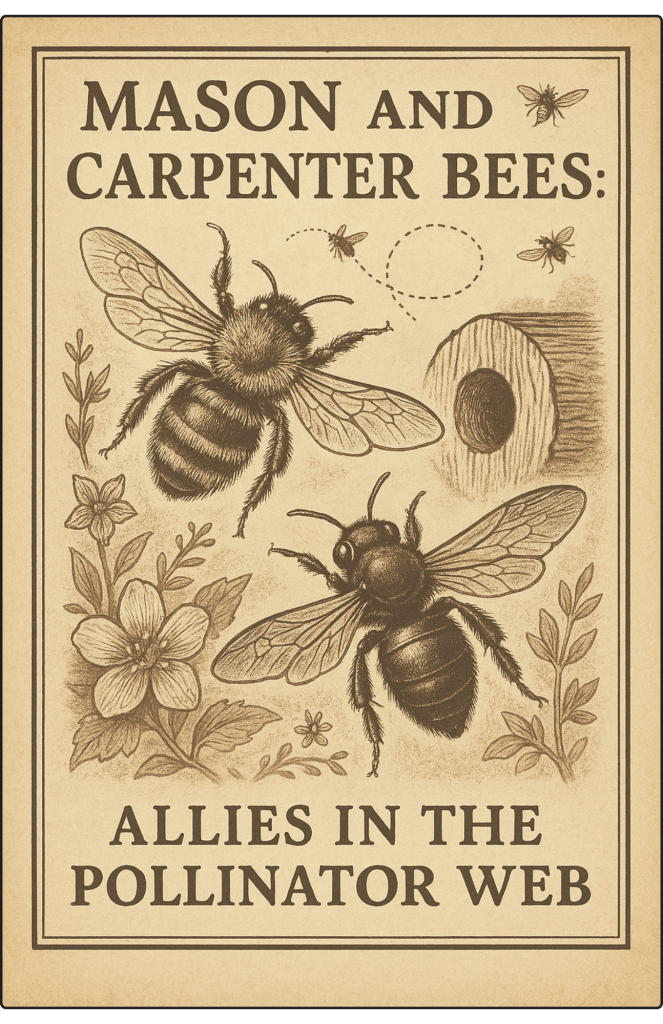
Mason and Carpenter Bees: Allies in the Pollinator Web
While honey bees often take center stage in discussions about pollinators, mason and carpenter bees are vital native species that contribute significantly to ecological health and food production. In treatment-free beekeeping and regenerative land stewardship, recognizing and supporting these solitary bees is essential.
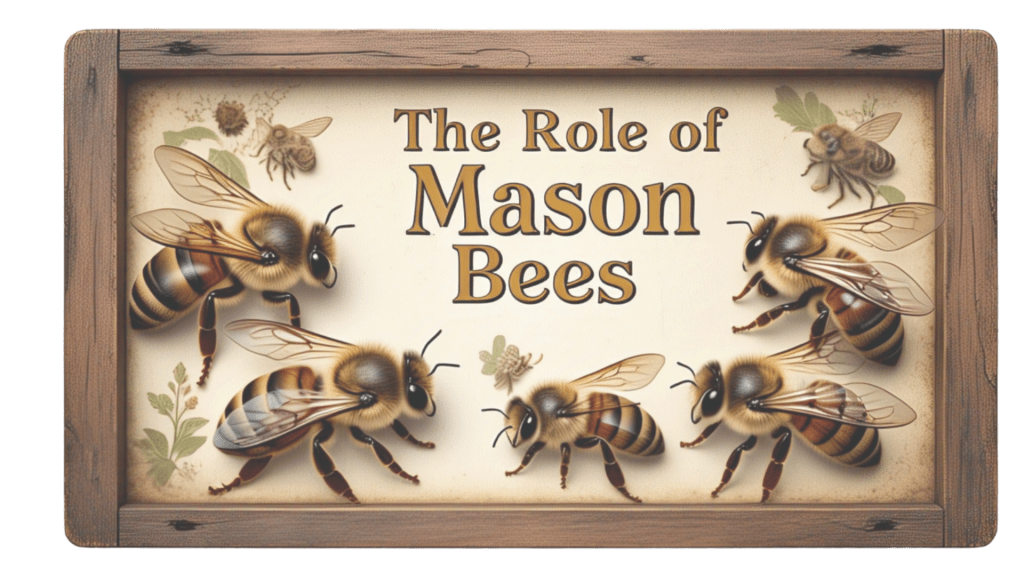
The Role of Mason Bees
Mason bees (Osmia spp.) are among the most effective yet underappreciated native pollinators in North America. Named for their use of mud to construct and seal their nests, these solitary bees exemplify the quiet power of nature at work. Without the social structure or honey production of their more famous cousins, mason bees devote nearly every moment of their short adult lives to one purpose: pollination and reproduction.
Unlike hive-dwelling bees, mason bees live independently. Each female is a fully functioning queen, responsible for gathering food, selecting a nesting site, and raising her young without any help from a colony. This independence makes them exceptionally resilient and adaptable. Because they don’t rely on a central hive, mason bee populations are less vulnerable to many of the diseases and parasites that afflict honey bee colonies.
Mason bees emerge in early spring, perfectly timed with the bloom of fruit trees and wildflowers. Their activity often coincides with a period when honey bees are still ramping up, making mason bees crucial for early-season pollination. Their slightly furry, compact bodies are ideal for carrying dry pollen, and their erratic, rapid foraging habits result in frequent flower contact—enhancing pollen transfer between blossoms.
They are particularly well-suited for orchard settings. Just a few hundred mason bees can outperform thousands of honey bees when it comes to pollinating apple, pear, and cherry trees. Because they don’t exhibit strict floral fidelity, mason bees cross-pollinate between tree varieties more effectively, increasing fruit set and yield.
Mason bees are also a joy to observe. Their shimmering blue-black bodies, quiet demeanor, and gentle presence make them welcome guests in any garden or landscape. They rarely sting, and when they do, it is only in direct defense and far less painful than a honey bee sting. For this reason, they’re often recommended for pollinator projects in schoolyards or family gardens.
These bees ask for very little: a place to nest, a nearby source of mud, and access to clean, early-season blooms. In return, they offer immeasurable value to ecosystems and food systems alike.
Welcoming mason bees is more than a gardening technique—it is a vote for biodiversity, resilience, and a gentler approach to pollination.
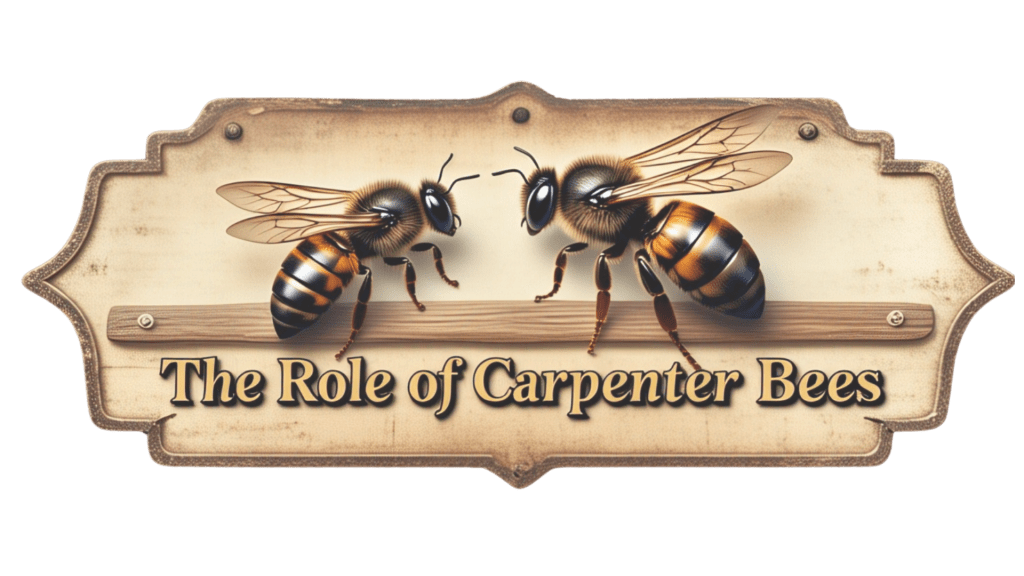
Carpenter bees (Xylocopa spp.) are often mistaken for bumblebees due to their size and coloring, yet their behavior and ecological contributions are distinct and essential. While they’ve earned an unfair reputation for boring holes into wood, their role in the pollinator web is far more constructive than destructive.
These bees are typically solitary, though some species exhibit semi-social behaviors with multiple females sharing the same nest gallery while maintaining individual brood cells. Each female is a self-sufficient forager and builder, excavating tunnels in untreated, weathered, or dead wood. This nesting habit mimics their natural preference for fallen logs and tree limbs, making carpenter bees important contributors to forest regeneration and decomposition cycles.
Pollination is where carpenter bees truly shine. They are powerful and precise buzz pollinators—performing sonication, a unique technique in which they vibrate their flight muscles to dislodge tightly held pollen from flower anthers. This is especially important for plants like tomatoes, blueberries, eggplants, and certain native wildflowers, which require vibration to release pollen. Honey bees cannot perform this function, making carpenter bees irreplaceable partners for these crops.
Because of their strength and larger size, carpenter bees can access blossoms that may be too tough or deep for smaller pollinators. Their robust bodies also carry pollen efficiently between flowers, and they often visit species overlooked by other bees. This contributes to greater floral diversity and genetic mixing in ecosystems where they thrive.
Males, although territorial and curious, are harmless. They often hover near nesting sites or flowers, investigating passersby with noisy enthusiasm. Since males lack stingers entirely, their behavior is more bluff than bite. Females can sting, but they are non-aggressive and rarely do so unless handled or trapped.
Carpenter bees are particularly important in ecosystems where native plant species dominate. Their co-evolution with these plants has led to efficient and mutually beneficial pollination dynamics that support the resilience and reproduction of native flora.
Supporting carpenter bees means embracing their need for nesting wood while directing them away from valued structures. Providing logs, untreated lumber, or dedicated wood piles can redirect their attention and preserve both pollinator populations and property.
Ultimately, carpenter bees remind us that not all beauty is delicate, and not all strength is loud. Their work is quiet, vital, and deeply woven into the health of landscapes that support food, flowers, and biodiversity which is crucial for crops like tomatoes, blueberries, and eggplants.

Pollen and Nectar Collection: Honey Bees vs. Mason and Carpenter Bees
Understanding the differences in how these bees gather pollen and nectar offers insights into their ecological roles and the value of biodiversity in pollination.
These differences highlight the complementary nature of native solitary bees and honey bees in an ecosystem. Their diverse foraging methods and preferences ensure a wider range of plants receive pollination support.
Understanding the differences in how these bees gather pollen and nectar offers insights into their ecological roles and the value of biodiversity in pollination.
Honey Bees (Apis mellifera):
- Collect nectar in a specialized honey stomach and return it to the hive to produce honey
- Pack pollen into “pollen baskets” (corbiculae) on their hind legs using moistened hairs and regurgitated nectar
- Tend to focus on a single plant species per foraging trip (floral fidelity), which enhances pollination efficiency for agriculture
Mason Bees (Osmia spp.):
- Do not have pollen baskets
- Carry dry pollen on the undersides of their hairy abdomens (scopa), which makes them messier but more effective pollinators
- Collect both pollen and nectar while moving quickly between diverse flowers, leading to high cross-pollination rates
Carpenter Bees (Xylocopa spp.):
- Also lack formal pollen baskets
- Carry pollen on coarse leg hairs and body fuzz
- Known for “buzz pollination”—vibrating flowers to release tightly held pollen, especially effective on crops like tomatoes and blueberries
These differences highlight the complementary nature of native solitary bees and honey bees in an ecosystem. Their diverse foraging methods and preferences ensure a wider range of plants receive pollination support.
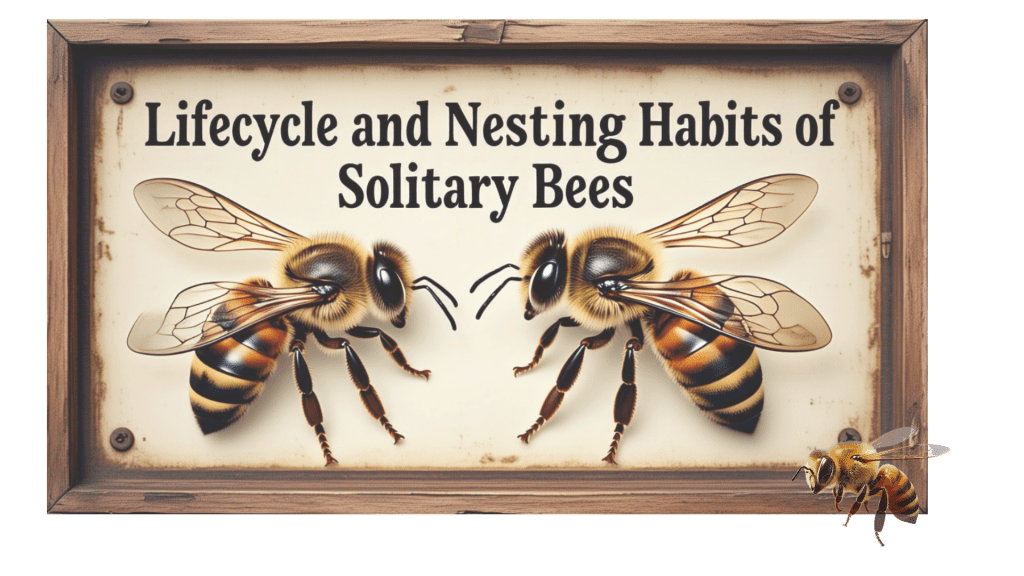
Lifecycle and Nesting Habits of Solitary Bees
The lifecycles of mason and carpenter bees reflect their independent nature and their deep attunement to seasonal rhythms. Unlike social bees that rely on hive coordination and collective brood care, solitary bees live self-directed lives—each female building, provisioning, and sealing her own nest with remarkable precision.
After mating in early spring, when temperatures warm and blossoms begin to open, female mason bees begin the search for a suitable nesting site. They prefer narrow cavities ranging from 3–8 mm in diameter—typically in hollow stems, beetle tunnels in wood, or pre-drilled holes in bee hotels. Inside these spaces, the female methodically builds a series of chambers. In each chamber, she deposits a single egg on a loaf of gathered pollen mixed with nectar, forming a rich provision that will feed the larva until it pupates. She then walls off the chamber using mud or damp clay, forming a secure barrier before starting the next one. This architectural sequence continues until the cavity is full.
Carpenter bees follow a more industrious route. The female selects untreated or decaying wood and uses her powerful mandibles to bore a near-perfectly round tunnel, often several inches long. She lays her eggs in a linear series, partitioned by chewed wood pulp or empty space. Unlike mason bees that use pre-existing cavities, carpenter bees are carpenters in the truest sense—designing and constructing their nesting tunnels from scratch.
Once eggs are laid, both mason and carpenter bee larvae hatch and begin consuming the pollen-nectar provision. Their development is relatively swift: larvae spin a cocoon, pupate, and complete their transformation over the summer months. However, they do not emerge right away. Instead, they enter diapause—a state of dormancy akin to hibernation—protected inside their sealed chambers or wooden galleries. This overwintering phase is critical and finely tuned to environmental cues. Come spring, as temperatures rise and day length increases, the adult bees chew their way out of the nest to begin the cycle anew.
Unlike social species that protect and thermoregulate their brood collectively, solitary bees rely on the stability of their environment to safeguard developing offspring. This makes them especially sensitive to disturbance, moisture shifts, and artificial heating during the winter. A premature warm spell or habitat disruption can result in early emergence and mortality, underscoring the importance of leaving nesting sites undisturbed through the seasons.
Each solitary bee nest—whether lined with mud or tunneled into wood—is a testament to maternal care, instinctual timing, and ecological harmony. These bees build with precision, trust in nature’s cycles, and leave behind no hive—only the quiet promise of future pollinators ready to rise with the spring bloom.
How Mason Bees Build with Mud and Water
Mason bees derive their name from their building behavior. After laying each egg in a chamber provisioned with pollen and nectar, the female collects mud or damp clay and uses it to seal the cell—creating a protective barrier. This mud partition helps protect developing larvae from moisture, parasites, and mold. To accomplish this, mason bees seek out moist, workable materials near their nesting sites.
This behavior highlights their reliance on specific natural resources:
- Mud or clay: Needed for walling off individual egg chambers
- Moisture: Essential to mold the mud into secure plugs
- Uncompacted, exposed soil: Preferred for easy access and transport
Carpenter bees, while not using mud, may line their tunnels with wood pulp or smooth the surfaces to create insulated nests. However, mason bees’ use of external building material like mud is unique and makes habitat support more practical.
How to Support Mason Bee Construction Needs:
- Create a mud station: A shallow dish or small depression filled with clayey soil kept moist
- Place it nearby: Within 20–30 feet of bee hotels to reduce energy spent gathering material
- Avoid pesticides: Especially around soil or water sources
- Use native clay-rich soils: If possible, to mimic natural conditions
By providing a consistent source of mud and water, you’re directly supporting the reproductive success of mason bees and helping to anchor their presence in your landscape.
How to Build a DIY Bee Hotel
Creating a bee hotel is a rewarding way to support mason bees:
- Use untreated wood blocks or bundles of hollow plant stems
- Drill holes 3–8 mm in diameter and 4–6 inches deep into wood blocks
- Ensure holes are smooth and closed at the back
- Mount hotels at eye level in a dry, sunny, sheltered area facing southeast
- Clean annually or replace used materials to avoid parasites and mold
Seasonal Support Calendar for Solitary Bees
Spring:
- Install bee hotels before bloom
- Provide early-blooming flowers (willow, crocus, lungwort)
Summer:
- Leave wildflower patches undisturbed
- Monitor bee hotels for use
Fall:
- Do not disturb nesting sites
- Allow plant stems and snags to remain
Winter:
- Shelter existing hotels
- Clean old materials and prepare new ones for spring
Addressing Common Concerns
Carpenter bees sometimes bore into wooden structures, which can be concerning. To discourage this:
- Provide dedicated deadwood away from buildings
- Use hardwood or painted surfaces for vulnerable areas
- Avoid pesticides or insecticides—they harm beneficial species
It’s important to remember that the ecological benefit of carpenter bees often outweighs any minor damage they may cause.
Companion Plants for Mason and Carpenter Bees
To attract and nourish these bees, plant a diversity of native flowering plants:
Early Season:
- Willow, red maple, crocus, lungwort
Mid Season:
- Bee balm, wild geranium, black-eyed Susan, phacelia
Late Season:
- Goldenrod, aster, sedum
Include tubular flowers for carpenter bees and open, shallow blossoms for mason bees. Providing blooms from early spring through fall ensures forage continuity.
Supporting Solitary Bees
Treatment-free and regenerative beekeepers can support mason and carpenter bees by creating habitat and minimizing disturbance.
Habitat Tips:
- Install bee hotels with nesting tubes for mason bees (3–8 mm diameter)
- Leave dead wood, snags, and stumps for carpenter bees
- Avoid painting or treating wood with chemicals
- Provide a shallow water source with stones for safe drinking
- Plant native flowers across seasons for continuous forage
Coexisting with Honey Bees
A common concern among gardeners and new beekeepers is whether native solitary bees and honey bees might compete for the same resources. However, research and field observation show that mason bees, carpenter bees, and honey bees tend to coexist with minimal conflict. Each species has unique foraging habits, floral preferences, and seasonal activity windows that allow them to share space rather than vie for it.
Mason bees emerge earlier in the spring than honey bees, thriving in cooler temperatures when managed hives may still be building strength. They often prefer native spring ephemerals and early-blooming trees like plum, cherry, or red maple—plants that may only later become a focus for honey bee colonies. Carpenter bees, in turn, gravitate toward larger, open-faced flowers or those requiring sonication, which are often bypassed by honey bees altogether.
This temporal and floral niche differentiation reduces competition and enhances pollination coverage across a wider range of plants. Where honey bees exhibit floral fidelity—visiting the same plant species repeatedly during a single foraging trip—solitary bees are more opportunistic, darting between many flower types. The result is complementary rather than competitive pollination, with each species increasing the reproductive success of different plants.
In regenerative apiaries and garden systems, this diversity strengthens the resilience of the entire ecosystem. When environmental conditions fluctuate, or one bee population is temporarily reduced, others can step in to fill the pollination gap. This creates a pollinator web that is more adaptable, more balanced, and better equipped to handle climate variability, pests, or disease outbreaks.
By actively supporting native solitary bees alongside our treatment-free honey bee colonies, we move beyond species favoritism and into a deeper practice of ecological stewardship. Solitary bees remind us that not all pollinators need to produce honey to be of immense value—and that fostering coexistence is not only possible, but essential.
To care for one species is to care for all. Every mud-sealed tube and every buzz-pollinated blossom contributes to the larger symphony of life—one where honey bees, mason bees, carpenter bees, and countless other native pollinators each play a vital role in the garden’s song.
A Story from the Garden: The Power of Small Wings
Last spring, I hung my first mason bee hotel on the southern wall of our garden shed—just a bundle of bamboo tubes in a weathered frame. I didn’t expect much, but within a week, several blue-black mason bees were busily investigating the tubes. By midsummer, every chamber was sealed with neat clay caps.
What surprised me most wasn’t just how quickly they moved in—but how the garden changed. Our apple tree, which had struggled to produce in years past, bore its heaviest fruit yet. Peas, berries, and even wildflowers flourished. – Debra 1st year treatment-free beekeeper
Meanwhile, a carpenter bee began visiting a cracked fence post each morning. I watched her buzz and vibrate the flowers that honey bees ignored—like the eggplant and passionflower. Her presence felt like a quiet blessing, a reminder of the wild intelligence woven through the garden.
These solitary bees asked for so little—some safe space and flowering kindness—and gave so much in return.

Foraging Range and Preferences
Solitary bees such as mason and carpenter bees are hyperlocal in their habits. Unlike honey bees that may fly miles from their hives in search of nectar and pollen, solitary bees typically forage within a modest range—often just 300 to 500 feet from their nesting site. This close proximity creates an intimate relationship between the bee and its immediate environment, making every flower, shrub, and tree within that radius a vital part of their survival.
This limited foraging range makes solitary bees particularly effective pollinators for backyard gardens, orchards, community plots, and small-scale farms. Their energy isn’t spent flying far and wide; instead, it’s invested in intensively working the blooms closest to home. As a result, they provide dense, repeated pollination coverage that benefits fruit set, seed development, and overall plant health.
Their floral preferences are broad and often opportunistic. Mason bees favor open, shallow flowers that bloom in the cool days of early spring, including wildflowers, fruit trees, and flowering shrubs. Carpenter bees, with their larger bodies and ability to sonicate, are drawn to deep-throated, open-faced flowers and often visit native plants that honey bees may ignore. Together, they provide pollination services across a diverse botanical spectrum, filling in ecological niches left untouched by other bees.
This close-range foraging also makes solitary bees excellent indicators of habitat quality. If local floral resources decline—due to development, chemical use, or climate shifts—the impact on solitary bee populations can be immediate and pronounced. Their survival depends not only on flower availability but also on continuous bloom throughout their active season. Gaps in bloom times can leave them without food, even if other seasons are abundant.
Supporting a thriving solitary bee population, then, means thinking spatially and seasonally. A variety of native plants blooming from early spring through late fall within a 500-foot radius of nesting sites ensures forage continuity. It also helps anchor bees to the area, reducing the likelihood that they’ll disperse or fail to reproduce.
Solitary bees don’t wander far, and that’s precisely what makes them such dependable partners in the pollination web. Their fidelity to place reflects the deeper rhythms of natural ecosystems—where proximity, timing, and relationship are everything.
By cultivating rich floral resources close to their nesting areas, we don’t just attract these bees—we nourish them. And in doing so, we amplify their ability to nourish the land in return.
Daily Activity Rhythms
Mason and carpenter bees operate according to rhythms set not by a queen or hive hierarchy, but by the land itself. These solitary bees rise with the sun, responding to local cues like light intensity, temperature, and the scent of newly opened blossoms. Their daily routines are beautifully attuned to the pulse of the environment—making them sensitive and responsive agents within the larger ecological system.
Typically, mason and carpenter bees begin foraging in the morning once temperatures reach the minimum threshold for flight—around 55°F (13°C) for mason bees and slightly warmer for carpenter bees. On cool spring mornings, you may notice mason bees emerging as early risers, already at work on the petals while the dew still clings to leaves. Their compact, insulated bodies allow them to forage in conditions that might ground honey bees for several hours longer.
Carpenter bees, though slightly more dependent on warmth due to their larger size, are also morning-active and may linger later into the afternoon during warmer months. Their buzzing flight is often heard just after the sun touches the wood where they nest, as they begin vibrating blossoms or hovering near their favorite floral sources. Because they don’t follow hive-based communication systems, these bees act individually, making micro-adjustments throughout the day based on sun exposure, flower availability, and wind patterns.
Solitary bees also show flexibility in their routines. Some will take short rest periods in shaded areas during the hottest part of the afternoon, resuming foraging as temperatures moderate. Unlike honey bees, whose workers may be directed toward specific tasks through the waggle dance and other forms of collective coordination, solitary bees operate by instinct and environmental feedback alone. Their sense of time is local, moment-by-moment, and deeply rooted in the microclimate of their nesting area.
This individual-based timing means their pollination work is often spread more evenly across a variety of plant species, and it allows them to capitalize on short weather windows that might otherwise go unused by more regulated pollinators. On days with intermittent sun, scattered rain, or shifting winds, solitary bees may be the only species consistently at work, darting between breaks in cloud cover or briefly reappearing after a passing shower.
Understanding these natural rhythms helps us better support solitary bee populations. By planting morning-blooming flowers near nesting sites, providing sheltered areas from midday heat, and maintaining a variety of floral sources throughout the day, we create environments that mirror and honor the bees’ preferred patterns.
Their rhythm is not rushed, not commanded—but responsive, intelligent, and free. Observing it teaches us to notice more, to sync with the land’s subtler cues, and to appreciate the quieter, slower cycles that guide all living things.
Nest Recognition and Navigation
One of the most remarkable traits of solitary bees is their precise spatial memory. Without maps, scent trails, or hivemates to guide them, female mason and carpenter bees navigate with stunning accuracy—locating their individual nests among dozens, sometimes hundreds, of nearly identical entrances. This capacity for pinpoint navigation is not only a marvel of nature—it is a key to their survival.
Upon leaving her nest for the first time, a solitary bee performs a series of orientation flights. These looping, circling patterns allow her to memorize the immediate surroundings using visual landmarks. She records the angles of light, the shape of leaves, the position of stones, and even the contrast of shadows. These elements form a mental map—a spatial snapshot that guides her back after each foraging trip.
Mason bees, in particular, rely heavily on high-contrast features like flower patches, bark textures, or even subtle changes in terrain. The more diverse and detailed the landscape, the more effective their navigation becomes. This is why placing bee hotels near garden edges, flowering shrubs, or textured surfaces can greatly aid in nest recognition. Flat, uniform surfaces by contrast can disorient or delay returning bees.
Carpenter bees, nesting in tunnels they excavate themselves, often show similar landmark learning behaviors. Some will hover and “hover-dance” near their tunnel entrance before departing—studying its orientation relative to the sun, the nearby plants, and even the contours of wood grain. These behaviors ensure that when they return carrying pollen or nectar, they waste no time searching.
In addition to visual memory, some solitary bees are thought to leave subtle chemical cues near their nest entrance—traces of their own scent or glandular secretions that help them differentiate their tube or tunnel from those of others. While these scent markers are not as elaborate as those of ants or social bees, they may serve as short-term beacons, especially in densely populated nesting blocks.
What’s more, studies suggest that solitary bees can learn and adapt quickly. If a visual cue is moved or removed, many will pause, reassess, and re-orient themselves—indicating a level of cognitive flexibility often underestimated in insects. This adaptability becomes especially important in dynamic environments where wind, rain, or human activity may shift the landscape.
The precision with which these bees navigate their world reveals an intelligence of place—a way of knowing rooted not in language, but in lived experience. Every trip away from the nest is followed by a return, guided not by external control but by deep attunement to the land’s smallest features.
For those who support solitary bees, offering a visually rich and stable environment is one of the greatest gifts. Clustered flowers, textured surfaces, and even garden ornaments can serve as visual anchors. In doing so, we don’t just make it easier for bees to find their way home—we become part of the map they carry in their minds.
Territorial and Nesting Behavior
Though solitary by design, mason and carpenter bees display an elegant balance between independence and community awareness. Unlike social bees that operate within a strict hierarchy, these native pollinators maintain their own nest sites and offspring—yet often choose to live in close proximity to others of their kind. This results in what could be called cooperative proximity: a non-social gathering where individuals respect spatial boundaries while sharing the broader habitat.
Female solitary bees are instinctively territorial when it comes to their own nests. While they do not defend a colony or queen, they are deeply attuned to the location and integrity of their individual nesting tube or tunnel. A returning female may briefly hover, patrol, or even physically confront another bee if she feels her entrance is being threatened or confused with another. These moments of vigilance are brief and rarely aggressive, but they demonstrate an impressive spatial awareness and an innate drive to protect her investment.
In nesting blocks or dense aggregations—such as bee hotels filled with suitable tubes—it’s not uncommon to see dozens of mason bees entering and exiting in rapid succession. Despite this bustle, each female recognizes her specific chamber and rarely makes a mistake. If one bee does approach the wrong entrance, a gentle nudge or push may follow, serving as a simple but clear form of boundary-setting. There is no coordinated defense, just an individualized sense of territory.
Carpenter bees, with their larger size and powerful mandibles, are equally attentive to their wooden nesting galleries. A female may spend considerable time crafting her tunnel and will often remain nearby while foraging. Although she is unlikely to engage in prolonged conflict, she may block or patrol her entrance if disturbed. Males, though stingless, often act as territorial sentinels—hovering near nesting wood or floral patches to chase off intruders or rivals in impressive mid-air displays. While this behavior may appear aggressive, it is entirely bluff—no harm comes from the encounter.
Interestingly, these territorial instincts do not translate to resource competition. Solitary bees foraging on the same flowers show tolerance and flexibility. It is the nest, not the nectar, that commands their attention. This speaks to their evolutionary strategy: invest heavily in protecting the next generation while sharing the landscape for daily sustenance.
The spatial etiquette of solitary bees offers a unique glimpse into nature’s ability to support both individuality and interconnection. These bees live alone, but not in isolation. Their nesting patterns mirror the broader principles of a healthy ecosystem—where mutual respect, gentle boundaries, and proximity without dominance allow life to flourish side by side.
As stewards of their habitat, we can honor these behaviors by offering ample nesting options, maintaining quiet zones around active bee hotels, and avoiding disturbances during nesting seasons. In doing so, we create a sanctuary not just for solitary bees—but for the quiet beauty of autonomy in balance.
Overwintering Strategies
For solitary bees like mason and carpenter bees, overwintering is not a pause—it is a vital phase of transformation. After spending the summer feeding and growing within their carefully prepared chambers, the larvae enter diapause, a dormant state in which growth halts and the body conserves energy. This natural resting phase typically begins in late summer or early fall and continues through winter until just the right environmental signals cue emergence.
Inside their sealed cocoons—whether behind a mud wall or deep in a carved tunnel—each bee rests encased in a finely tuned microclimate. Temperature, humidity, and insulation all play critical roles in determining survival. Unlike honey bees that cluster together for warmth in a communal hive, solitary bees overwinter completely alone, relying on the integrity of their nesting site to shield them from moisture, cold snaps, and predators.
Mason bees often overwinter as fully developed adults inside their cocoons, ready to emerge as soon as spring temperatures consistently rise. Carpenter bees typically overwinter in their natal tunnels, where they remain as mature larvae or pre-pupae, completing development when spring cues arrive. Both species are exquisitely synchronized with the timing of local blooms; they emerge not according to a fixed calendar date, but in rhythm with the flowering of key plants in their environment.
However, this delicate cycle can be easily disrupted. Warmer winters, erratic freeze-thaw cycles, or artificial heat sources—such as home heating vents or sun-exposed walls—can cause bees to emerge too early. If flowers are not yet blooming or temperatures suddenly drop again, these premature emergents face starvation or freezing. Likewise, excessive moisture caused by rain infiltration or condensation can lead to mold and decay within nesting chambers.
To support healthy overwintering, it’s essential to protect nesting sites from disturbance. Bee hotels should be placed in sheltered areas, out of direct winter wind and rain. In colder regions, storing removable nesting blocks or tubes in unheated, predator-safe shelters—such as sheds or garages—can help preserve stable conditions. For carpenter bees, leaving standing deadwood or old fence posts undisturbed through winter provides natural refuge.
Avoiding cleanup too soon in early spring is another important act of stewardship. Dead stems, logs, and even dried flower stalks may still house bees that have not yet emerged. Waiting until mid- to late spring before trimming or composting garden debris ensures that overwintering solitary bees are not accidentally destroyed just before they emerge.
In every dormant cocoon lies a quiet promise: that life will return, that pollination will begin again, and that the land will be nourished once more. By protecting that stillness through the winter months, we become guardians of a process far older and more intricate than we can fully grasp.
Let us respect the silence of these hidden chambers and the patient intelligence within them. For even as the landscape slumbers, solitary bees are preparing—slowly, invisibly—for the miracle of spring.

You Are a Solitary Bee Steward
You don’t have to be a beekeeper with honey-producing hives to make a lasting difference. By supporting mason and carpenter bees, you’re playing a vital role in ecological restoration and biodiversity. These native pollinators quietly do the work of sustaining ecosystems—helping fruits set, flowers bloom, and native plants persist.
Creating just one bee hotel, offering a small patch of wildflowers, or providing a source of mud and water can support dozens—sometimes hundreds—of solitary bees. Each action you take sends ripples across your local landscape.
Let us call this role what it truly is: a Solitary Bee Steward. These are the quiet guardians of biodiversity. Whether you tend a suburban yard or a rural garden, your care for these bees contributes to a regenerative and resilient world. And in doing so, you become part of a growing movement—one rooted in reverence for life’s smallest and most essential workers.
A Natural Partnership
Every bee species brings a gift—an evolutionary refinement that supports the whole. From the precise floral fidelity of honey bees to the messy, cross-pollinating efficiency of mason bees and the muscular buzz of carpenter bees, each pollinator plays a role that no other can fully replace. Together, they weave an intricate network of nourishment, resilience, and renewal.
In a regenerative apiary, we do not ask bees to conform to our systems—we adjust our systems to support theirs. This means recognizing the needs of solitary bees alongside our managed colonies, offering a landscape that welcomes difference rather than uniformity. It means seeing pollination not as a service to be extracted, but as a relationship to be honored.
Mason and carpenter bees offer a model of quiet power. They work alone, unheralded, without the glory of honeycomb or the spectacle of a swarm. Yet their impact echoes through every early blossom, every tomato harvest, every unexpected flush of wildflowers. Their efficiency is born not of organization, but of elegant instinct. Their strength lies in simplicity.
To make space for these native bees is to practice reverent inclusivity—to remember that not all heroes are loud, and not all productivity comes in golden jars. The small mud-sealed tubes behind your garden shed, the faint tunnel in the old fence post, the gentle hum beneath your blooming lavender—these are signs that life is being sustained, not in spectacle, but in steadiness.
This partnership isn’t symbolic—it’s functional, foundational, and profoundly mutual. When we provide diverse forage, nesting materials, and safe, untreated spaces, we invite balance. We reduce our dependence on one species. We help buffer ecosystems against stress, and we give nature the layered resilience it needs to thrive.
Invite them in. Let the land buzz with diversity. Let your garden, orchard, or apiary become a place where different wings fly together—not in competition, but in chorus.
In doing so, we shift from being beekeepers to becoming caretakers of a greater pollinator web—a living partnership between soil, bloom, and bee.
 The Natural Beekeeper's Path Nonprofit