
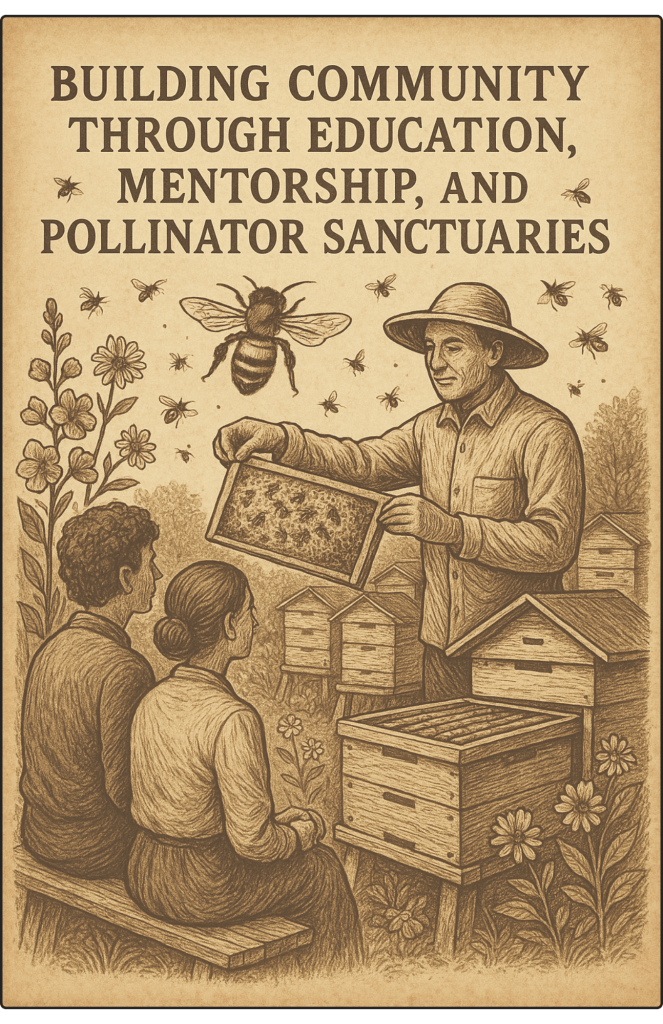
Building Community Through Education, Mentorship, and Pollinator Sanctuaries
Treatment-free beekeeping is more than a solitary act—it is a ripple that moves through community, culture, and landscape. As we heal our relationship with the bees, we are also called to help others remember theirs. This chapter explores how to extend the ethics and practices of treatment-free beekeeping beyond your apiary through education, mentorship, and the creation of spaces that nurture pollinators and people alike.
The Role of the Educator-Beekeeper
Teaching others does not require a title or certification. It begins with willingness—the openness to share your experiences, listen to others, and guide from humility. Every beekeeper has a story to tell, and often the most powerful lessons come not from perfection, but from honesty.
Whether you’re giving a talk at a community center, hosting a backyard hive tour, or chatting with a neighbor over the fence, your words carry seeds. By explaining why you’ve chosen the treatment-free path—and showing the joy, challenge, and beauty it entails—you help others reconsider their own approaches.
Simple acts can catalyze change: offering books, hosting bee-friendly gardening classes, or inviting local children to observe hive inspections. Every engagement is a chance to reweave the connection between humans and pollinators.
Mentorship: Walking the Path Together
Mentorship is a sacred relationship. It is less about instruction and more about accompaniment. As a mentor, you become a mirror, a sounding board, and a source of steady encouragement. You hold space for questions, setbacks, and discoveries. You model presence, patience, and deep listening.
Mentorship in treatment-free beekeeping also means modeling reverence—for the bees, the land, and the rhythms of nature. It is not about having all the answers, but about helping others learn how to ask better questions.
Consider creating a local mentorship circle or bee club that embraces chemical-free values. Encourage group visits to apiaries, shared problem-solving, and seasonal check-ins. The hive teaches us that learning is communal. Mentorship honors that wisdom.

Creating Pollinator Sanctuaries
Pollinator sanctuaries are spaces of restoration and invitation. They can be as small as a window box or as large as a community garden. The goal is to offer forage, shelter, and safety—not just for honey bees, but for native pollinators, butterflies, and beneficial insects.
Designing a sanctuary begins with diversity. Include native plants that bloom from early spring to late fall. Provide shallow water sources, leave bare ground patches for nesting bees, and avoid pesticides altogether. Incorporate wild edges, flowering hedgerows, and companion plants that support the whole ecosystem.
In urban settings, even rooftops, balconies, and schoolyards can become sanctuaries. Invite community members to participate. Teach them to see beauty in wildness and value in the untamed.
A pollinator sanctuary is more than a garden—it is a living classroom, a medicine wheel, and a prayer made visible.
Advocacy and Outreach
Beyond our hives and gardens, we can shape the larger culture of care for pollinators. Join or form advocacy groups that protect wild habitats, limit pesticide use, or promote ecological farming. Write to local officials about bee-safe policies. Support legislation that strengthens biodiversity and soil health.
Social media, blogs, podcasts, and videos offer powerful ways to share your journey. Be visible. Show that treatment-free beekeeping is not fringe—it is a regenerative path whose time has come.
You might also partner with schools, libraries, botanical gardens, or spiritual centers to co-host events and amplify your reach. The more integrated pollinator consciousness becomes, the more resilient our communities grow.
Embodying the Hive Ethos
In every hive, individual bees serve the whole—not from obligation, but from inner alignment. When we extend our beekeeping beyond the box and into the heart of our culture, we too act from that place of service.
Education, mentorship, and sanctuary-building are acts of remembrance. They help others recall that humans once lived in close partnership with pollinators. They plant the seeds for a future where this relationship is restored.
As you walk this path, remember: you are not alone. Every kind word, every shared insight, every garden planted in love becomes part of the great pollination—carrying life, truth, and healing from one being to the next.
 The Natural Beekeeper's Path Nonprofit