
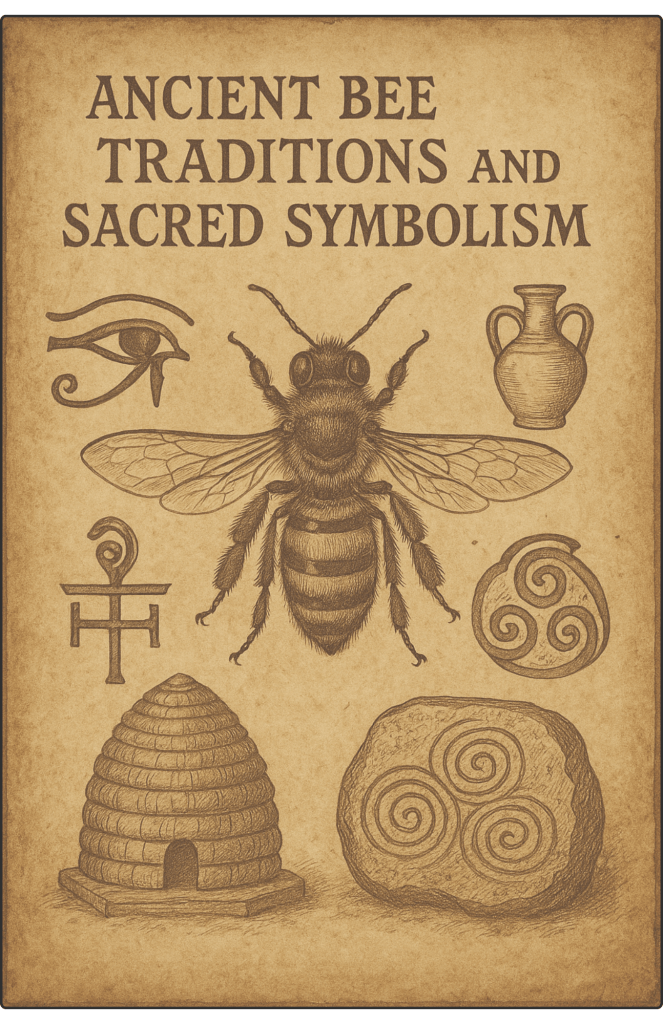
Ancient Bee Traditions and Sacred Symbolism

Mythology and Symbolism
Throughout human history, bees have buzzed at the edge of myth and meaning. In ancient Greece, they were seen as emissaries of the divine. The oracle of Delphi was tended by priestesses called Melissae—”the bees”—who were believed to receive prophecy through their sacred connection to the insect world. Bees were considered messengers of the gods, capable of moving between worlds and whispering truths to those who listened (Ransome, 1937).
In Egyptian mythology, bees were born from the tears of the sun god Ra. As those tears struck the desert sands, they transformed into buzzing life—symbols of resurrection, diligence, and eternal cycles (Wilson, 2006). Honey, seen as the golden food of the gods, was placed in tombs to sweeten the soul’s journey to the afterlife. Bees appeared in hieroglyphs connected to divine kingship and cosmic harmony, and entire temples were dedicated to their care.
Celtic lore also held bees in reverence. They were thought to carry the souls of the dead and were kept informed of family births, deaths, and marriages—an ancient practice known as “telling the bees” (Heinrich, 2004). This belief symbolized the bee’s deep connection to the cycles of life and the unseen realms. In Irish tradition, bees were thought to communicate with the spirit world and were never to be spoken of in anger.
Sacred Beekeeping Practices
In many ancient cultures, beekeeping was considered a sacred act. Temples in Egypt, Mesopotamia, and later in Greece and Rome maintained hives as offerings to the gods (Crane, 1999). Honey was among the earliest known ritual substances—used in libations, sacrifices, and as a preservative for sacred herbs.
In Greece, the Melissae were women trained in spiritual service and honeycraft, and their bee-centered wisdom was tied to goddess traditions, especially Artemis and Demeter. They viewed hives as temples in miniature—reflecting cosmic harmony in the alignment and geometry of the comb (Rigoglioso, 2009).
Among the Maya, the stingless bee Melipona beecheii was treated with deep reverence. Ceremonies included chants, incense, and carved stone hives placed in sacred groves. Bees were believed to be divine intercessors, and honey was used in shamanic rituals and rites of healing (Roubik, 1995).
Royal and Esoteric Use of Bee Imagery
The bee has long stood as a symbol of divine order and sacred kingship. In Egypt, pharaohs were titled “He of the Sedge and the Bee,” reflecting the unification of Upper and Lower Egypt (Wilkinson, 2003).
Napoleon chose the bee as a symbol of immortality and industry, adorning his robe and regalia with hundreds of golden bees to signify his alignment with ancient dynasties (Fraser, 2004). His use of the bee intentionally connected his regime to the early Merovingian kings, whose tombs held bee-shaped artifacts.
Freemasons and other esoteric schools employ the beehive as a symbol of order, unity, and the sacred nature of work. In Rosicrucian thought, bees represent the initiated soul, and their hive is the heart-temple of the mystical path (Hall, 1928).
Medicinal and Magical Uses
Bees and their gifts have been central to healing traditions across cultures. Greek physician Hippocrates prescribed honey for wounds and infections. Ayurveda and Chinese medicine both value honey for its balancing and preserving effects. Propolis was known as a natural antibiotic even in ancient Rome (Crane, 1999).
Magically, beeswax candles were burned to send prayers and invoke clarity, and honey was used to anoint altars and sacred tools. Bee venom therapy, used in modern times to ease arthritis and pain, was practiced in traditional Eastern medicine and indigenous ritual contexts.
Honey jars—ritual tools in Hoodoo and folk magic—continue a long-standing tradition of sweetening outcomes and nourishing love, harmony, and abundance (Yronwode, 2002).
Bees in Alchemy and Spiritual Transformation
In alchemy, the transmutation of nectar to honey mirrors the transformation of base emotions to wisdom. The hive is a crucible where nature creates a golden elixir—honey—that nourishes and heals. Alchemists saw the bee as a symbol of the adept, gathering essence from the many and refining it into truth (Jung, 1967).
The queen bee embodies the divine feminine principle: she does not rule by force, but by presence and fertility. Her pheromones harmonize the hive, much as spiritual insight harmonizes the soul.
Bees’ relationship to flowers represents the soul’s pilgrimage through life’s lessons. As they return to the hive and share nectar through dance and food, so too does the wise initiate return from inner journeys with gifts to offer the collective.
Bees and the Afterlife Across Cultures
In many spiritual traditions, bees were seen as intermediaries between the worlds of the living and the dead. In ancient Greece, bees were said to escort souls to the afterlife and were associated with the Eleusinian Mysteries and the soul’s rebirth. In Celtic customs, the tradition of “telling the bees” ensured the colony stayed connected with the human household through all life events—especially death. It was believed that failing to inform the bees could lead them to abandon the hive in grief.
In Slavic and Germanic folklore, bees were messengers to the Otherworld, and their appearance after a death was seen as a sign from departed spirits. Some funerary rites included placing a bit of honey or beeswax with the deceased as a final gift and guide for the journey beyond.
Astrological and Cosmic Associations with Bees
Bees have long been linked to the stars. In astrology, bees are most often associated with the sign Virgo—symbolizing fertility, order, and nurturing. Virgo’s link to the harvest and the sacred feminine mirrors the hive’s cycles of reproduction and care.
In ancient star maps and planetary metaphors, bees were aligned with solar qualities—vitality, golden light, and community—but they also carried lunar significance through their nocturnal vibrations and the reflective quality of wax. The hexagon, central to bee comb, echoes throughout cosmology and sacred geometry as a representation of universal harmony.

Bees in Literature and Mystical Poetry
Bees have inspired spiritual poetry for centuries. In the writings of Sufi mystics like Rumi, bees are symbols of divine intoxication—drawn toward the nectar of love and lost in ecstatic service. Rumi writes of the bee’s dedication and longing, likening its pursuit of nectar to the soul’s yearning for union with the Beloved.
In Virgil’s Georgics, bees were emblems of noble labor and divine inspiration. Monastic scribes of medieval Europe described bees as carriers of heavenly wisdom, and early Christian poets celebrated their harmony and devotion.
Bees in Early Christianity and Monastic Life
In medieval monasteries, beekeeping was considered a sacred vocation. Monks and nuns cared for hives not only for honey and wax but as part of a contemplative path. The hive symbolized the Church—orderly, fertile, harmonious.
Saint Ambrose, one of the early Church Fathers, was associated with bees from infancy when a swarm is said to have landed on his lips, marking him for future eloquence. He later became the patron saint of beekeepers, scholars, and candle makers.
Beeswax candles were essential in sacred liturgy, valued for their pure, smokeless flame—a symbol of Christ’s divine light. The Exsultet, a hymn sung during Easter vigil, explicitly praises the “work of the bees” in creating the candle that carries the flame of resurrection.
Bee Sound and Sacred Vibrations
Recent scientific studies are beginning to explore the physiological effects of sound frequencies similar to those produced by bees. A 2019 study published in Scientific Reports found that exposure to low-frequency vibrations (including frequencies close to the average bee hum, around 200–250 Hz) may positively influence heart rate variability and induce a parasympathetic (relaxation) response in the human body (Kim et al., 2019).
Furthermore, the field of vibroacoustic therapy—a clinical form of sound healing—has documented therapeutic benefits using sound waves in the 20–120 Hz range. Although bee hums are slightly higher in frequency, their layered harmonic vibrations have been anecdotally reported to help reduce anxiety and elevate mood. Some contemporary beekeepers and sound healers even create meditative recordings of hives for mindfulness practices.
Observations by holistic beekeepers suggest that intentional, quiet sitting near a healthy hive can be grounding and deeply restorative, akin to forest bathing or sound meditation. The subtle changes in hive tone also provide intuitive insight into colony health—serving as a non-invasive diagnostic tool for experienced listeners.
Thus, the bee’s buzz becomes more than a sound—it is a vibrational bridge between beings, a natural frequency that invites coherence, presence, and peace.
Together, these traditions weave a timeless message: the bee is not only a pollinator of plants, but of wisdom, soul, and sacred community. By remembering and honoring these ancient associations, we deepen our modern connection to the hive—not just as keepers, but as co-creators in the dance of life.
Sources Cited:
- Crane, Eva. The World History of Beekeeping and Honey Hunting. Routledge, 1999.
- Fraser, Antonia. Napoleon: His Wives and Women. Anchor Books, 2004.
- Hall, Manly P. The Secret Teachings of All Ages. 1928.
- Heinrich, Bernd. The Buzz About Bees. Harvard University Press, 2004.
- Jung, Carl. Alchemical Studies. Princeton University Press, 1967.
- Rigoglioso, Marguerite. The Cult of Divine Birth in Ancient Greece. Palgrave Macmillan, 2009.
- Roubik, David. Ecology and Natural History of Tropical Bees. Cambridge University Press, 1995.
- Wilson, Penelope. Hieroglyphs: A Very Short Introduction. Oxford University Press, 2006.
- Wilkinson, Toby. The Thames & Hudson Dictionary of Ancient Egypt. Thames & Hudson, 2003.
- Yronwode, Catherine. Hoodoo Herb and Root Magic. Lucky Mojo Curio Co., 2002.
 The Natural Beekeeper's Path Nonprofit